Project
Introducing a Slovenian wastewater-treatment solution at Antique National School, alongside local training and school hygiene education.
Project at a glance
Partner country: Philippines
Location: Antique National School, San Jose de Buenavista, Antique Province
Duration: 2026–2027
Planned budget: EUR 61,004
Treatment capacity: 23–40 cubic metres per day
Expected users of the system: Approximately 1,000 students and 60 staff members using the school’s main building
Planned reach of WASH education: Approximately 7,600 students
PROJECT SUMMARY
The International Center for Promotion of Enterprises (ICPE), together with the Embassy of the Republic of Slovenia in Manila, developed a project to improve wastewater management and school hygiene at Antique National School in San Jose de Buenavista, Antique Province, Philippines. ICPE is coordinating the project through implementation, working with Slovenian and Philippine partners to connect wastewater-treatment technology with local infrastructure needs, training and education.
Planned for 2026–2027, the project combines a biological wastewater-treatment system with school-based water, sanitation and hygiene (WASH) education and training for local personnel. It aims to improve sanitation, protect local water resources and support a healthier learning environment.
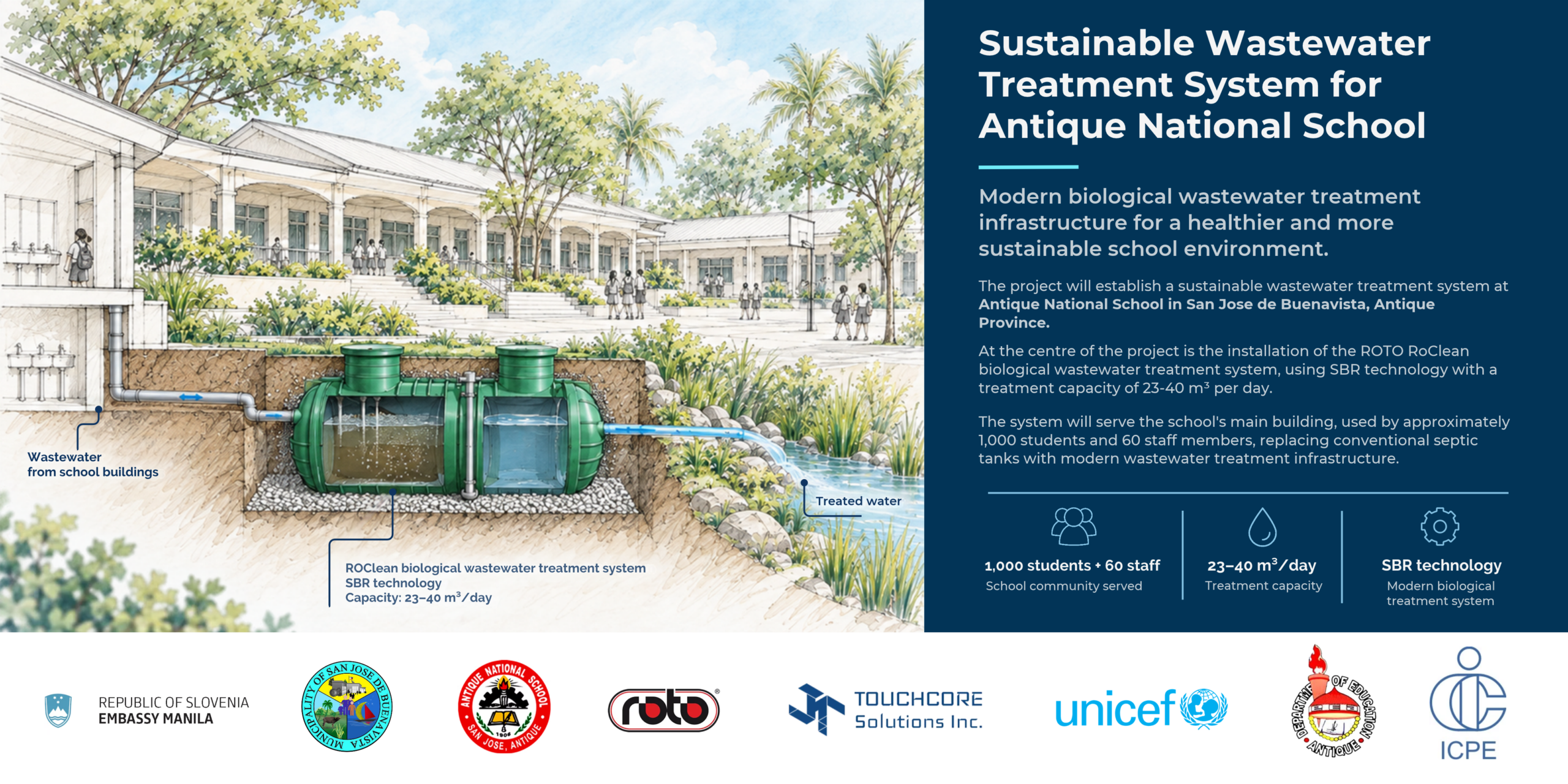
A ROTO RoClean biological wastewater-treatment system will serve the school’s main building, used by approximately 1,000 students and 60 staff members. With a planned capacity of 23–40 cubic metres per day, the system will use sequencing batch reactor (SBR) technology. The project plans for the treated wastewater to meet Philippine environmental requirements, including a target biochemical oxygen demand (BOD) level below 20 mg/L. Installation measures are intended to take account of local flooding and typhoon risks.
WASH education is planned for approximately 7,600 students across the school. Activities will include menstrual health and hygiene education for girls, as well as sessions involving boys in promoting gender equality and reducing stigma. These activities are intended to support students’ health, dignity and participation in education.
To support the system’s continued operation, the project includes practical training for at least five representatives of the school and local government, an English-language maintenance manual, and a school Water and Sanitation Committee. TouchCore Solutions is expected to provide 12 months of technical mentoring and monitoring.
PROBLEM DEFINITION
The need for the project
Antique National School currently relies on septic tanks for wastewater management. The project responds to the need for improved wastewater treatment at the school’s main building. It pairs a new treatment system with training and maintenance arrangements so that local personnel can take part in operating and caring for the system after installation.
Philippine context: sanitation and school WASH
The project addresses a wider service challenge in the Philippines. A World Bank project document reports that only about 3% of domestic wastewater was treated nationally, using data available for its 2024 assessment. The document links inadequate wastewater treatment and disposal with health risks, groundwater contamination and pollution of rivers. These national figures describe the wider context; they are not measurements of Antique National School or Antique Province.
School water, sanitation and hygiene services also remain uneven. A 2025 World Bank project document reports that, based on its cited national data, around 45% of schools had basic drinking-water access, more than one quarter had no water service, and only about one quarter met the ideal toilet-to-student ratio. The Department of Education’s WinS programme recognizes that inadequate water and toilet facilities, hygiene supplies and funding for operations and maintenance can affect student health, attendance and learning. The national picture therefore includes both infrastructure gaps and the practical challenge of keeping school facilities functional.
The project contributes at the scale of one public school. It is designed to improve wastewater treatment for the main building used by approximately 1,000 students and 60 staff members, while WASH and menstrual health and hygiene activities are planned to reach approximately 7,600 students across the school. Laboratory testing, local training, a maintenance manual, a school Water and Sanitation Committee and 12 months of technical mentoring and monitoring are intended to address the operational capacity needed to sustain the investment. This is a concrete local service improvement and capacity-building effort; it should not be described as solving the wider national sanitation gap.
A Slovenian solution and technology transfer
A central feature of the project is the introduction of a Slovenian wastewater-treatment solution in a Philippine school setting. ROTO, a company headquartered in Slovenia, supplies the ROTO RoClean system selected for the project. ROTO describes its RoClean SBR systems as biological treatment systems that process wastewater in batches through aeration, settlement and treated-water discharge. The project-specific system is planned for a capacity of 23–40 cubic metres per day.
The technology-transfer element extends beyond delivery of equipment. The project combines the system’s introduction and installation with technical supervision, training for school and municipal personnel, an English-language maintenance manual, a school Water and Sanitation Committee, and 12 months of technical mentoring and monitoring by TouchCore Solutions. These activities are intended to help local personnel understand the system and maintain it over time.
This cooperation connects Slovenian technical expertise with Philippine infrastructure needs and local responsibility for operation and maintenance. The project summary does not indicate local production or transfer of intellectual property; the page therefore describes transfer of technology and operational know-how rather than local manufacture.
Planned activities
- Install and commission the ROTO RoClean biological wastewater-treatment system, with a planned capacity of 23–40 m³ per day.
- Connect the treatment system to the wastewater infrastructure serving the school’s main building.
- Provide training for at least five school and municipal personnel in operation and maintenance.
- Prepare and use an English-language maintenance manual and establish a school Water and Sanitation Committee.
- Deliver WASH and menstrual health and hygiene activities for approximately 7,600 students.
- Provide 12 months of technical mentoring and monitoring through TouchCore Solutions.
- Test treated wastewater in a laboratory and assess performance against applicable Philippine requirements, including the project target for BOD below 20 mg/L.
Expected results
The project aims to provide an operational wastewater-treatment system for the school’s main building, strengthen local capacity to operate and maintain it, and expand hygiene education across the school. Project targets include training at least five school and municipal personnel and reaching approximately 7,600 students through WASH and menstrual health and hygiene activities.
The supplied project summary also sets a target of at least a 20% reduction in absenteeism related to water-related illness. This should be presented as a target, not a guaranteed result. Public reporting against it should follow an agreed baseline and monitoring method.
PLANNED PROJECT PHASES
The schedule below reflects the plan provided by the project team. It should be labelled as a plan until progress against each phase is confirmed.
Preparation and planning
January–June 2026
Planned work
Site surveys, technical planning, coordination with local partners, and preparation of transport and installation arrangements.
Civil works and initial hygiene education
July–December 2026
Planned work
Site preparation and construction works, alongside initial WASH and menstrual health and hygiene workshops.
Delivery and installation
January–June 2027
Planned work
Delivery and installation of the treatment system, connection to the school’s wastewater infrastructure, and technical supervision.
Commissioning and capacity building
April–August 2027
Planned work
Test operation, laboratory analysis of treated wastewater, training for school and municipal personnel, and further hygiene education.
Final review and project completion
July–October 2027
Planned work
Final technical checks, communication with the school community and reporting, supported by arrangements for continued maintenance and technical mentoring.
PROJECT PARTNERS
The project partnership brings together
- the Embassy of the Republic of Slovenia in Manila,
- the Municipality of San Jose de Buenavista,
- Antique National School,
- ROTO Slovenia,
- TouchCore Solutions and
- ICPE.
Planned educational activities will involve
- UNICEF Philippines, with institutional support from
- the Department of Education’s Antique Schools Division.
The partnership combines Slovenian technology and expertise with local implementation and arrangements for continued operation and maintenance.
ROTO provides the treatment technology and technical support; TouchCore Solutions provides local implementation support and 12 months of technical mentoring and monitoring.
Contribution to the Sustainable Development Goals
The project’s primary contribution is to SDG 6. Its other links arise from the project’s health, school hygiene, menstrual health education, technical training and partnership activities. These should be described as contributions or areas of alignment, rather than as proof that the project will achieve the SDGs by itself.
SDG 6 – Clean Water and Sanitation (Primary contribution)
The project contributes to improved wastewater treatment, sustainable sanitation management and hygiene education. It directly supports SDG target 6.2, which focuses on access to adequate sanitation and hygiene, and target 6.3, which addresses water quality, pollution reduction and wastewater treatment.
SDG 3 – Good Health and Well-being (Supporting contribution)
Improved sanitation and hygiene practices aim to reduce exposure to inadequately treated wastewater and associated health risks, contributing to healthier and safer school environments.
SDG 4 – Quality Education (Supporting contribution)
Improved sanitation infrastructure and hygiene education contribute to a healthier and more inclusive learning environment. The project supports SDG target 4.a, which promotes safe, inclusive and effective educational facilities.
SDG 5 – Gender Equality (Supporting contribution)
Menstrual health and hygiene education supports girls’ health, dignity and participation in education. Activities involving boys aim to reduce stigma, promote gender equality and encourage shared responsibility for hygiene practices.
SDG 12 – Responsible Consumption and Production (Supporting contribution)
The project promotes responsible wastewater management through the introduction of biological treatment technology, supported by local technical training and sustainable operation and maintenance practices.
SDG 17 – Partnerships for the Goals (Cross-cutting contribution)
The project strengthens cooperation among Slovenian and Philippine public institutions, educational stakeholders, technology providers and international partners. Through knowledge transfer, capacity building and institutional collaboration, the partnership supports sustainable project implementation and long-term local ownership.
The SDGs are presented as areas of contribution. The project is a local initiative and should not be represented as independently achieving any global goal.