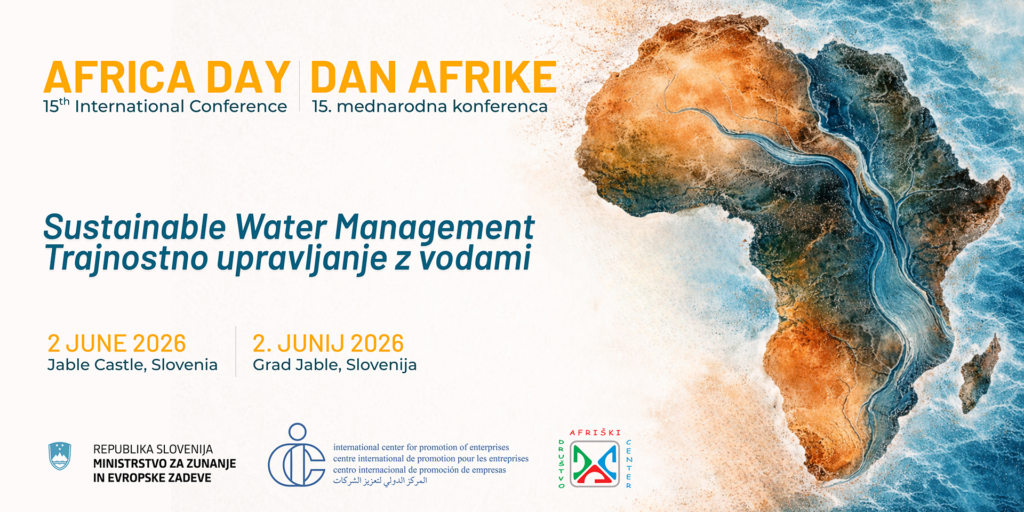
On 2 June 2026, the 15th Africa Day International Conference was held at Jable Castle, Slovenia, under the theme Sustainable Water Management. The conference was co-organised by the Ministry of Foreign and European Affairs of the Republic of Slovenia, the International Center for Promotion of Enterprises (ICPE) and the African Community Hub/Afriški Center.
The event brought together more than 100 participants, including accredited African ambassadors, representatives of Slovenian institutions, companies, research organisations, development actors, members of the African diaspora and other partners engaged in strengthening cooperation between Slovenia and African countries.
This year’s Africa Day placed water at the centre of the discussion. Water was addressed as a strategic development issue connected with climate resilience, food security, energy, public health, agriculture, industrial development and human security. The conference also reflected the African Union’s focus on sustainable water availability and safe sanitation, as well as the growing importance of water governance in the implementation of Agenda 2063 and the Sustainable Development Goals.
The opening part of the conference included remarks by Prof. Zlatko Šabič, Advisor to the President of the Republic of Slovenia, Ms Neva Grašič, State Secretary at the Ministry of Foreign and European Affairs, and Mr David Tavželj, Executive Director of ICPE. The speakers underlined the importance of continued dialogue between Slovenia and African countries, while also emphasizing the need to connect such dialogue with concrete cooperation, practical projects and long-term partnerships.
DEVELOPMENT COOPERATION WITH AFRICA
The first panel focused on development cooperation with Africa and placed Slovenia’s engagement with African partners in a practical implementation context. The panel brought together perspectives on the EU Global Gateway initiative, Slovenia’s water diplomacy, development cooperation projects implemented through Slovenian institutions and ICPE’s approach to connecting institutional, technical and business capacities. The discussion underlined that cooperation should be guided by partner-country priorities, sustainability, fairness and local ownership, while also recognising that practical results require technical knowledge, implementation capacity and long-term partnerships between public institutions, research organisations and responsible business partners.
The Global Gateway presentation framed the initiative as both the EU’s investment strategy and a response to the global investment gap, with a focus on trusted and mutually beneficial partnerships. It highlighted digital connectivity, climate and energy, transport, health, education and research, together with the need for high-quality infrastructure, clean and green investment, transparency, equal partnerships and private sector involvement. Through Team Europe and Team Slovenia, the discussion pointed to a more coordinated approach in which development cooperation, internationalisation support, investment finance and partner-country priorities can be connected more effectively.
Water diplomacy was presented as one of Slovenia’s key areas of engagement with African partners. The discussion focused on the water and peace nexus, transboundary water cooperation, the water and climate nexus, gender equality and a human-rights-based approach. Concrete examples included projects in East Africa that combined access to water with training, community management, women’s empowerment and conflict-resolution mechanisms, as well as the use of micro-satellite technology and digital twin models for climate-resilient water management on transboundary rivers. The panel also highlighted Slovenia’s cooperation with African partners in international water diplomacy, including work on water and peace, transboundary water cooperation and preparations for the UN Water Conference.
The panel further presented Slovenia’s development cooperation projects in Africa, including water treatment in Kenya, remote-sensing support for drinking water management in Uganda, sustainable tomato value-chain development in Egypt, blockchain-based cooperation in Tanzania and planned initiatives in Ghana and Kenya. These examples showed how development cooperation can move from general dialogue to applied projects, combining Slovenian knowledge, local priorities, technology transfer, training and practical institutional cooperation.
ICPE’s contribution placed emphasis on relevance, frugal innovation and long-term sustainability of development projects. The presentation stressed that technology transfer should be adapted to local conditions, re-engineered with local partners where necessary, and connected with business models capable of sustaining projects beyond initial development funding. In this context, development funding was discussed as a way to reduce risk, test practical solutions and support models that can later be taken forward by local partners and the private sector.
GUEST OF HONOUR
Morocco was the Guest of Honour of this year’s conference. The dedicated panel on Morocco’s Water Transition: A Platform for African Partnership, Mutual Learning and Co-creation presented Morocco’s national and local experience in addressing water security, climate resilience and sustainable water governance. The presentation highlighted Morocco’s position in North Africa, one of the world’s most water-scarce regions, where water availability is closely linked with agriculture, tourism, industry and infrastructure. Moroccan representatives presented the country’s key water challenges, including uneven distribution of water resources, the impact of prolonged drought, exceptional flood risks and high irrigation demand. They also outlined Morocco’s response through major water infrastructure, including large, small and medium dams, water transfer systems, desalination, wastewater treatment and reuse, drinking water supply, irrigation modernisation and the development of non-conventional water resources. Particular attention was given to Morocco’s National Water Policy 2050, which marks a shift from infrastructure alone toward science-based governance, innovation, digital tools, renewable energy, public-private partnerships, capacity building and climate resilience. The discussion also connected Morocco’s national experience with its wider African role, including its engagement within the African Ministers’ Council on Water and the Africa Water Vision and Policy 2063.
PRESENTATIONS OF AFRICAN ECONOMIES
The programme also included presentations of African economies and national development priorities. Participating countries presented opportunities and challenges in areas such as water management, agriculture, energy, mining, infrastructure, tourism, industrialisation, value addition, climate adaptation and investment. Contributions from participating African countries demonstrated the diversity of African economic priorities and the relevance of water for national development strategies. Presentations addressed Algeria, Burkina Faso, Egypt, Rwanda, Sudan, Tunisia, Zambia and Zimbabwe.
The presentations of African economies provided a broad overview of national development priorities and possible areas for cooperation with Slovenian partners. Rwanda presented its economy through the lenses of growth, stability and implementation capacity, highlighting services, ICT, logistics, health services, industrial zones, manufacturing, agro-processing, pharmaceuticals, textiles, packaging and energy, while also positioning the country as a gateway for investment, innovation and trade. Zambia placed water security at the centre of economic growth, linking it directly with mining, agriculture, energy, tourism, public health and climate resilience. Algeria presented its role as a major economic and energy partner connecting Europe, Africa and the Mediterranean, with priorities in natural gas, hydrogen, renewable energy, industrial development, logistics, agriculture, irrigation, food security, critical raw materials, water management technologies and digital transformation. Egypt addressed water security as a strategic and existential issue, emphasizing transboundary water management, desalination, reuse, water treatment, financing and triangular cooperation combining African priorities, Egyptian expertise and European capabilities. Burkina Faso presented opportunities linked to industrialisation, local value addition, mining, agro-processing, cotton, sesame, mangoes, shea products, renewable energy, water infrastructure, recycling, irrigation and green technology transfer. Sudan underlined the role of agriculture, livestock, minerals, oil, hydropower and the Nile in its economy, while also drawing attention to the need for recovery, reconstruction and partnerships following severe damage caused by the ongoing conflict. Zimbabwe framed water as a cross-cutting economic enabler for agriculture, mining, energy, manufacturing and tourism, with cooperation opportunities in water purification, wastewater treatment, hydrological research, basin modelling, renewable-powered water infrastructure, climate-smart irrigation and water-efficient agriculture. Tunisia highlighted water security as an essential condition for future economic development, presenting priorities related to drinking water supply, network rehabilitation, desalination, dam modernisation, water transfer infrastructure, wastewater reuse, irrigation efficiency, digitalisation and circular water management.
SLOVENIA WITH AFRICAN PARTNERS
The conference also presented Slovenian knowledge, technologies and institutional capacities relevant to African partners. Slovenian companies and research organisations showcased solutions in water infrastructure, wastewater treatment, environmental technologies, geoscience, groundwater, satellite and space applications, artificial intelligence, digital tools and nature-based solutions. These contributions demonstrated areas where Slovenian expertise can support practical cooperation with African partners, particularly where water, climate resilience, environmental protection and local development priorities intersect.
Roto Group presented its experience in African markets and its water-related products and solutions. The Geological Survey of Slovenia presented expertise in geoscience, groundwater, geohazards, environmental geology, geoenergy and geoinformatics. IRCAI, hosted at the Jožef Stefan Institute, presented the role of artificial intelligence for sustainable development, including responsible and human-centred AI applications. LIMNOS presented nature-based solutions, including constructed wetlands for wastewater treatment, with emphasis on low-energy, adaptable and locally relevant approaches for rural and isolated communities.
ECONOMIC COOPERATION SLOVENIA-AFRICA
Economic cooperation between Slovenia and African countries formed an important part of the conference. SPIRIT Slovenia presented Slovenia as an export-oriented and internationally connected economy, with strengths in sustainability, water management, environmental technology, circular economy, green infrastructure, renewable energy, advanced industry, digitalisation, satellite applications and smart solutions. The presentation also highlighted ongoing Slovenian business activities and institutional engagement with African markets, including Morocco, Algeria, Egypt, Zambia, Tunisia and Nigeria.
The Chamber of Commerce and Industry of Slovenia presented the importance of practical preparation, credible local partners, institutional support and long-term engagement in African markets. The discussion also referred to the planned establishment of a Slovenian-African Business Council, intended to support information exchange, partner searches, business delegations, institutional cooperation and the preparation of concrete activities with African partners.
The programme further included contributions from Pomurski sejem, with a focus on the AGRA Fair as a platform for agriculture, food, rural development and international business exchange, and from EMUNI University, which presented opportunities for academic and regional cooperation in the Euro-Mediterranean space, including links with North African partners.
The role of the African diaspora in Slovenia was also recognised as an important part of the wider cooperation environment. Through the cultural programme and participation of the African Community Hub / African Centre, the conference highlighted the contribution of the African community to intercultural dialogue, people-to-people contacts and stronger links between Slovenia and African countries.
The second day of the programme continued in the framework of the Bled Water Forum, where discussions focused further on water resources, climate resilience and technological innovation. This connection placed Africa Day within a wider professional discussion on water governance and sustainable development.
The 15th Africa Day International Conference confirmed that Slovenia–Africa cooperation is moving toward a more practical phase. The discussions showed clear potential to connect diplomacy, development cooperation, research, business capacity and locally grounded partnerships. Water management served as the central theme, while the wider message of the conference was broader: future cooperation will depend on the ability to translate dialogue into concrete initiatives, credible partnerships and development results.
Photo gallery and more information about the conference are available here.